 Padua City Guide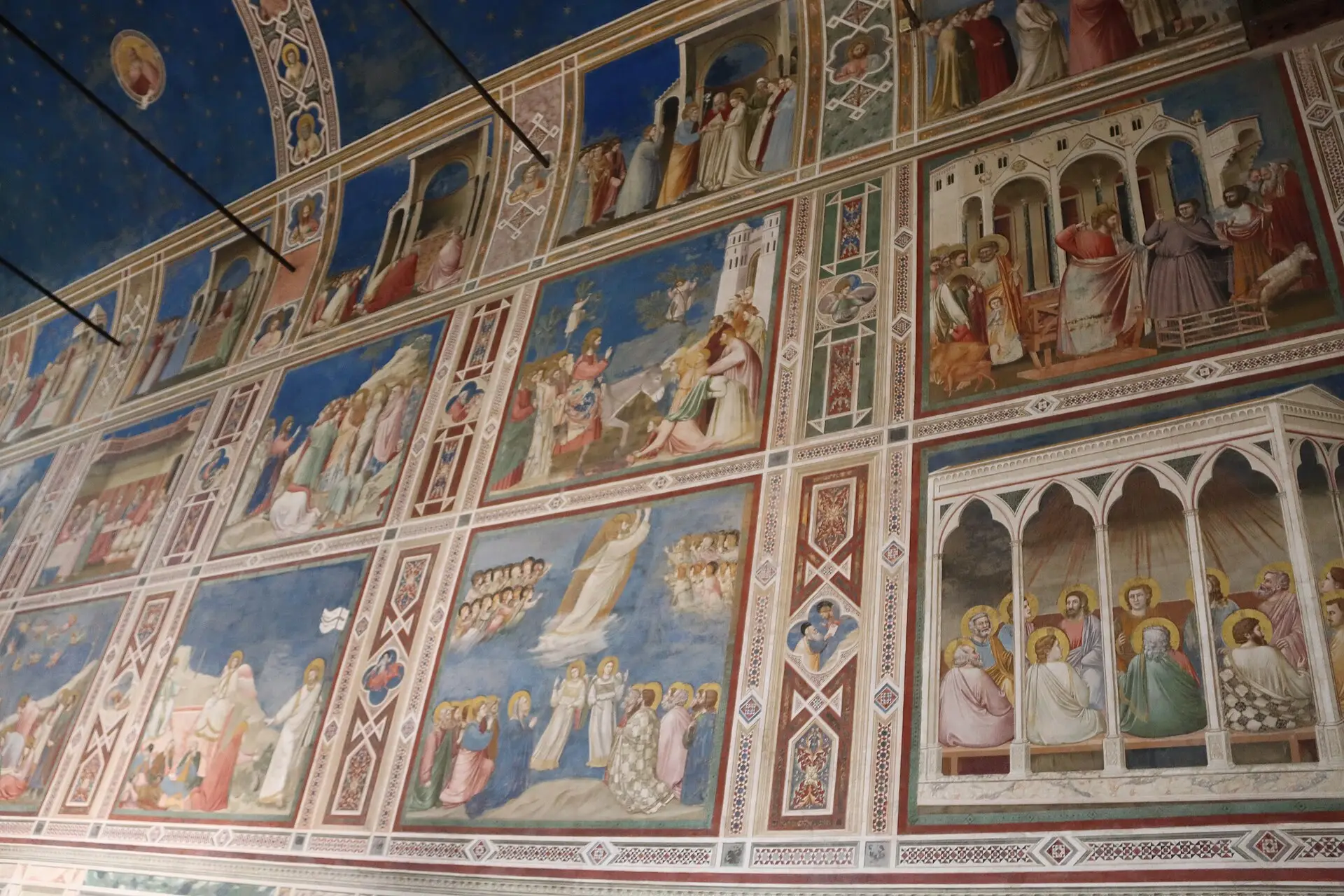
The scrovegni chapel holds the most complete surviving interior Giotto ever painted: a frame-by-frame narrative of nearly forty scenes, executed in roughly two years around 1303-1305, that reset the direction of Western painting. It is also the most organised twenty minutes of sightseeing in Padua. Entry runs on strict 15-minute timed slots with mandatory booking, through a climate-controlled airlock that protects the seven-hundred-year-old plaster, and the ticket doubles as admission to the civic museums that surround it — so the visit is engineered as a half-day block, not a walk-in stop. This page covers what the booking portal does not explain: how the slot system works on the day, what to look at inside the fresco programme, the usurer's fortune that paid for the walls (Dante fixed the family purse in the Inferno), the evening Giotto sotto le stelle openings, and the Roman Arena ruins in the park outside. Prices, hours and booking steps were checked on the official channels on 12 September 2026. Pair the visit with the market squares — Piazza delle Erbe is ten minutes on foot — or with coffee at Caffè Pedrocchi. For everything else the city offers, start from the Padua City Guide homepage.
Quick answer Slot times, ticket prices, booking steps and the 15-minute rule
Checked on 12 September 2026: the chapel is open daily 9:00-19:00 (last entry 18:45) all year, closing only on 1 January, 1 May and 25-26 December — it is not shut on Mondays. Every visit runs in a 15-minute timed slot with mandatory booking. The combined ticket costs €15.00 plus a €1.00 booking fee (€16.00 total; reduced €11.00, residents €7.00) and includes the Museo Eremitani and Palazzo Zuckermann. Book through the Vivaticket portal or on +39 049 2010020, arrive 30 minutes early, and note that late arrivals forfeit the slot; photography is banned inside. Slots sell out weeks ahead in season — plan with our how far ahead to book Scrovegni guide and the full Scrovegni Chapel tickets breakdown, then add Piazza delle Erbe to the same morning.
Key takeaways
- €16.00 total per adult: €15.00 combined Musei + chapel ticket plus the €1.00 mandatory booking fee; reduced €11.00, residents €7.00.
- Open daily 9:00-19:00, last entry 18:45; closed only on 1 January, 1 May and 25-26 December — no Monday closure.
- Booking is mandatory: pick a 15-minute slot online or on +39 049 2010020, arrive 30 minutes early for the airlock.
- Late arrivals forfeit the slot — build in a buffer and keep your personal booking code at hand.
- The same ticket covers Museo Eremitani and Palazzo Zuckermann; the Padova Card and Urbs Picta routes are compared below.
Key facts
Opening hours
| All year, daily (chapel slots and museums) | 09:00–19:00 |
|---|
Closed Open every day except 1 January, 1 May and 25-26 December; NOT closed on Mondays. Last entry 18:45. Slots run at fixed 15-minute intervals through the day
Admission
- Adult
- €16.00 total: combined Musei + chapel ticket €15.00 plus the €1.00 mandatory booking fee
- Reduced
- €11.00 total (reduced combined ticket plus booking fee); residents €7.00
- Free
- No general free category is published — confirm current concession rules on padovamusei.it before relying on one
Planning it
- Time needed
- 15 minutes in the chapel; half a day with the two museums
- Book ahead
- Essential — weeks ahead
- Address
- Piazza Eremitani 8, 35121 Padova (entrance and ticket desk inside the Musei agli Eremitani)
Why Giotto came to Padua: Enrico Scrovegni's act of restitution
The chapel exists because of money made the medieval way and repented the medieval way. Enrico Scrovegni was a banker and moneylender of the first rank, and the son of Reginaldo Scrovegni, a usurer so notorious that Dante — writing in the following decade — condemned a soul identified by the azure sow of the Scrovegni arms, painted on its money pouch, among the usurers in the seventeenth canto of the Inferno. That soul is read as Reginaldo. Enrico, who inherited both the fortune and the reputation, bought the grounds of the ruined Roman arena on Padua's northern edge, raised a palatial residence for his family there, and attached a private chapel dedicated to Santa Maria Annunziata, consecrated in 1305.
Whatever mix of prestige, family memory and penance moved him, the commission he gave was without precedent: Giotto and his workshop covered the entire interior — nave walls in three narrative registers, the triumphal arch, the chancel and the barrel vault — in around two years of work between 1303 and 1305. Enrico was painted into the scheme himself, kneeling at the west wall as he presents a model of the chapel, a patron preserved in fresco a few metres from the infernal usurers with their purses. His monumental tomb, attributed to the workshop of Giovanni Pisano, stands in the chancel. The family palazzo that shared the plot was progressively demolished in later centuries; the chapel survived, and its climate system installed in the 2000s is the latest layer of that same story of protection.
- 1303-1305: Giotto and his workshop fresco the entire interior in roughly two years.
- 1305: the chapel is consecrated to Santa Maria Annunziata.
- c. 1308-1320: Dante's Inferno XVII fixes the Scrovegni purse — and the family's reputation — among the usurers.
- Chancel: Enrico Scrovegni's monumental tomb, attributed to Giovanni Pisano's workshop.
- 2000s: the climate-control airlock is installed, making the 15-minute slot system possible.
The fresco programme: 38 panels, three registers and a star vault
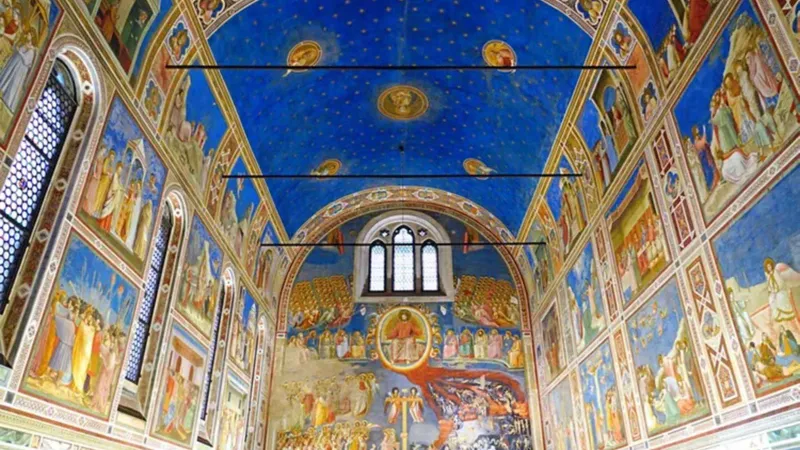
The chapel is a single, closed box of painting, and the programme reads like a book. Thirty-eight framed narrative scenes survive across the nave walls, arranged in three horizontal registers that run from the story of Joachim and Anne — the Virgin's parents — through the life of Mary and the childhood and public life of Christ, down to the Passion, the Lamentation, the Resurrection and Pentecost at the bottom band. The triumphal arch carries the Annunciation and Visitation, the hinge between the Old Testament promises and their fulfilment. Over everything floats the vault: a deep field of blue scattered with gilded stars, the lapis-and-gold sky that gives the room its peculiar weightlessness and that made ultramarine, the pigment of the sky, the most expensive thing in the room.
What separates the cycle from every fresco room you have seen before it is the behaviour of the figures. Giotto's people turn their backs, kiss, grieve and pull faces; weight sits on feet; a single blue cloak in the Lamentation folds like cloth rather than symbol. The Lamentation on the north wall — the scene that painters copied for the next two centuries — and the Kiss of Judas are the two compositions worth positioning yourself for in advance, because your fifteen minutes go quickly. The west wall, behind you as you enter, is the Last Judgement in full: Christ in judgement, the apostles, heaven and hell stacked in bands, Enrico kneeling with his model of the chapel, and — in the lower register — the damned usurers with money pouches strung round their necks, the trade that paid for the very walls they hang on.
The chapel wall by wall
Use this breakdown to order your fifteen minutes. The chapel is small enough that you can see every panel, but the best compositions deserve deliberate seconds rather than leftover ones.
| Zone | Position | Subjects to find |
|---|---|---|
| Vault | Ceiling | Deep blue field with gilded stars; the medallions of Christ, the Virgin and the prophets |
| Top register | Nave walls, upper band | Joachim and Anne: the rejection of Joachim, the golden gate, the birth of Mary |
| Middle register | Nave walls, centre band | The Virgin's marriage and the childhood and public life of Christ: the baptism, the wedding at Cana, the miracles |
| Bottom register | Nave walls, lower band | Passion week: entry into Jerusalem, the Kiss of Judas, the Crucifixion, the Lamentation, the Resurrection, Pentecost |
| Triumphal arch | Altar end | Annunciation and Visitation, painted as if the arch itself were part of the architecture |
| West wall | Behind you on entry | Last Judgement: Enrico presenting the chapel model, the apostles, hell with the usurers and their purses |
| Chancel | Altar end, apse | Enrico Scrovegni's tomb and the altar setting |
Reading Giotto in fifteen minutes
Walk in, let your eyes adjust to the dark, and start with the vault rather than the walls — the star field sets the tone and everything below it plays against that sky. Then take the registers in order on the wall to your left, moving towards the altar, because the narrative runs in sequence. Reserve the last third of your slot for the Lamentation and the west wall's Last Judgement — the portal sits inside the Judgement wall, so the scene you exit under is the one Dante's generation read as the frame of every life.
Staff move groups on promptly; there is no way to linger for a second look without booking another slot.
Ticket figures below come from the official chapel site (cappelladegiscrovegni.it), the Padova Musei network (padovamusei.it) and the city tourism board (turismopadova.it), checked on 12 September 2026. Every chapel visit, in every format, requires a booked 15-minute slot; the tour rows are optional guided departures that include admission.
Book a standard combined slot at €16.00 total unless you are collecting all eight UNESCO fresco sites, in which case price the Urbs Picta Card first.
| Option | What it covers | Price | Where to book | Book |
|---|---|---|---|---|
| Standard 15-minute slot (combined ticket)Almost everyone | Chapel slot + Museo Eremitani + Palazzo Zuckermann | €16.00 total (€15.00 + €1.00 booking); reduced €11.00; residents €7.00 | Official chapel site | Official site |
| Booking portalEveryone who has chosen a slot | Pick date and 15-minute slot; a personal booking code is issued | €1.00 booking fee is part of the totals at left | Vivaticket portal | Official site |
| Padova Musei network infoMuseum-first planners | Combined ticket terms, museum hours, concession categories | Same €16.00 / €11.00 / €7.00 structure | Padova Musei | Official site |
| Padova Urbs Picta CardUNESCO-cycle collectors | One entry to each of 8 UNESCO fresco sites + unlimited city transport; the chapel still needs a booked slot | 48h €28.00 / 72h €35.00 | turismopadova.it | Official site |
| Guided Tour of Giotto's Scrovegni ChapelFirst-time visitors who want the art history unpacked | About 1-1.5 hours with a licensed guide | See tour card | Check Availability | Check Availability |
| Padua evening tour with chapel admissionAfter-dark visitors | About 2 hours, ending in the chapel | See tour card | Check Availability | Check Availability |
How the 15-minute slot system works, start to finish
The slot system is not a queue-management trick — it is conservation equipment. The plaster that carries Giotto's colours is sensitive to humidity, temperature and, above all, the carbon dioxide that visitors breathe out, so the chapel admits a fixed number of people for exactly fifteen minutes and then rests. Bookings are made for a named 15-minute interval through the Vivaticket portal, and every booking generates a personal code: bring it on paper or on your phone. Telephone bookings run through the same system on +39 049 2010020. There is no walk-in admission; the desk sells leftover slots only when they exist.
On the day, arrive at least 30 minutes before your interval at the ticket desk inside the Musei Civici agli Eremitani, next to the chapel. Staff check your code, issue or validate your combined ticket, and point you to the airlock — the glass vestibule on the chapel's flank where each group waits through a short climate-decontamination cycle while the previous group leaves. Bags, umbrellas and bulky items go to the cloakroom first; the vestibule opens, you step through, and the fifteen minutes begin. When they end, staff usher the group out and the cycle repeats for the next booking. Miss the window and you forfeit admission: the code does not transfer to another interval without the desk's agreement, and re-admission depends on what remains unsold that day, which in season means nothing. The single most common bad review of the chapel is a late arrival, not the art.
A slot-day schedule that works
Build the visit backwards from your booked interval. This schedule assumes a standard morning slot and folds the museums into the same half-day.
| Time | Where | What happens |
|---|---|---|
| T-60 min | City centre | Walk or take the tram towards Piazza Eremitani — see the map below |
| T-30 min | Ticket desk, Musei agli Eremitani | Redeem your booking with the personal code; drop bags at the cloakroom |
| T-15 min | Airlock vestibule | Climate wait with your group; staff brief the rules — no photos, no food, no phone screens |
| T-0 to T+15 | Inside the chapel | Your 15 minutes with the frescoes, timed by staff |
| T+15 min | Museo Eremitani | Continue into the archaeological galleries and picture gallery on the same ticket |
| T+90 min | Palazzo Zuckermann | The second half of the combined ticket, two minutes away |
Rules inside: photos, bags and the fifteen-minute clock
Photography of any kind is banned inside the chapel — no photos, no video, no smartphone shots through the doorway; staff enforce it, and the ban is the price of the airlock system that keeps the chapel open at all. Bags larger than a small purse go to the cloakroom before the vestibule, not into the chapel. Eating, drinking and loud conversation end at the door.
The fifteen minutes are real: staff count them down and will move the group on, and the next group is already waiting in the airlock. If you want longer, book two slots at intervals — visitors do — or come back for an evening session, which has its own rhythm.
The rest of the €16: Eremitani, Zuckermann and the Roman Arena
The combined ticket is designed as a half-day, and the half-day is worth designing. The Musei Civici agli Eremitani wrap around the chapel on Piazza Eremitani: the archaeological section reconstructs Roman Padua — inscriptions, mosaics and the finds from the forum — and the picture gallery above it runs from fourteenth-century panels to eighteenth-century Venetian painting, with several works by Giotto's circle and by artists whose names the chapel's visit makes suddenly relevant. In the same complex, the church of the Eremitani keeps the Ovetari Chapel, Andrea Mantegna's early fresco cycle: largely destroyed in a 1944 air raid and painstakingly reassembled from thousands of fragments, it is a sobering counterpoint to the chapel's perfection two steps away.
Palazzo Zuckermann, the second museum on the ticket, stands a couple of minutes' walk towards the centre and holds the decorative-arts and numismatic collections: the city's coin series, applied arts and craft objects, arranged in a quieter, cooler building that most visitors have entirely to themselves. Budget forty-five minutes to an hour there. Back outside, the third monument costs nothing at all: the chapel stands inside the arcaded remains of the Roman amphitheatre that gave this district its name, and the Giardini dell'Arena — the park that fills the arena's bowl — is a public garden of plane trees, benches and exposed masonry where the queue for the next slot gathers on sunny days. Enter the park from Piazza Eremitani and walk the curve of the old seating before your interval; it is the only part of the visit you can photograph freely.
- Museo Eremitani: archaeological section and picture gallery — included in the ticket, same building as the chapel entrance.
- Church of the Eremitani: Mantegna's Ovetari Chapel frescoes, reassembled after 1944 bomb damage.
- Palazzo Zuckermann: decorative arts and the coin collection, five minutes towards the centre.
- Roman Arena and Giardini dell'Arena: the amphitheatre ruins and public park around the chapel — free, always open.
Evening openings, cards and booking strategy
Two things change the standard visit. The first is Giotto sotto le stelle, the chapel's evening-opening programme: on scheduled evenings the chapel admits visitors after the museums close, with a separate booking portal (giottosottolestelle.it) and a schedule published season by season. The room is dimmer, the groups smaller and the atmosphere entirely different from the daytime conveyor; if your dates coincide with an evening session, it is the calmest way to see the cycle. Check the schedule before you lock your daytime slot, and if the evening session is sold out, the guided evening tour with chapel admission in our catalogue is the reliable fallback.
The second variable is the card question. The chapel's own combined ticket (€16.00 with booking fee) already covers the two museums, so the Padova Urbs Picta Card — €28.00 for 48 hours or €35.00 for 72 hours, covering one entry to each of the eight UNESCO fresco sites plus unlimited city transport — pays off only if the Baptistery, the Oratorio di San Giorgio and the other painted sites are on your list; the chapel slot still has to be booked separately in every case. Book the chapel first, structure the days around the slot confirmation, and only then decide on the card — the arithmetic in is Padua Card worth it works the same for the Urbs Picta product. If the whole enterprise feels heavy, our honest accounting in is Scrovegni chapel worth it settles it in about four minutes of reading.
- Giotto sotto le stelle: scheduled evening openings, separate portal giottosottolestelle.it, seasonal calendar.
- Chapel slot always booked separately — no card bundles the 15-minute slot itself.
- Urbs Picta Card: €28.00 (48h) or €35.00 (72h) for 8 UNESCO sites + transport; best for two-site-plus days.
- Catalogue evening tours bundle admission and a guide — see the tour list below.
Four ways to see the frescoes compared
Prices and formats come from the official chapel site and portal, the Padova Musei pages and turismopadova.it, checked on 12 September 2026. Every option that includes the chapel requires a booked 15-minute slot; the card covers site entries, not the slot itself.
| Option | What you see | Time window | Price |
|---|---|---|---|
| Standard day slot | 15 minutes in the chapel + Museo Eremitani + Palazzo Zuckermann | Daily 9:00-19:00, last entry 18:45 | €16.00 total (€15.00 + €1.00 booking); reduced €11.00; residents €7.00 |
| Evening slot (Giotto sotto le stelle) | The cycle after dark, smaller groups, quieter room | Scheduled evenings — calendar on giottosottolestelle.it | Set per session on the evening portal |
| Guided evening tour | A guided Padua walk ending with chapel admission | About 2 hours, evening departures | See tour card |
| Padova Urbs Picta Card | One entry to each of 8 UNESCO fresco sites + unlimited city transport (chapel slot booked separately) | 48 hours or 72 hours | €28.00 (48h) / €35.00 (72h) |
The chapel Enrico Scrovegni built beside his palazzo, still framed by the arcades of the Roman amphitheatre.
The Eremitani quarter on the map
The chapel, the ticket desk, both museums and the Arena park sit inside one compact block on the northern edge of the old town. The pins below cover the whole slot-day route.
Guided tours that include the Scrovegni Chapel
Because the chapel's own slot system is rigid, tours that bundle admission remove the booking risk and add the art-historical narration the 15 minutes alone cannot carry. Both departures below are checked against our catalogue.
 from $45.25
Guided Tour of Giotto's Scrovegni Chapel
The fresco deep-dive with the slot handled for you
Check Availability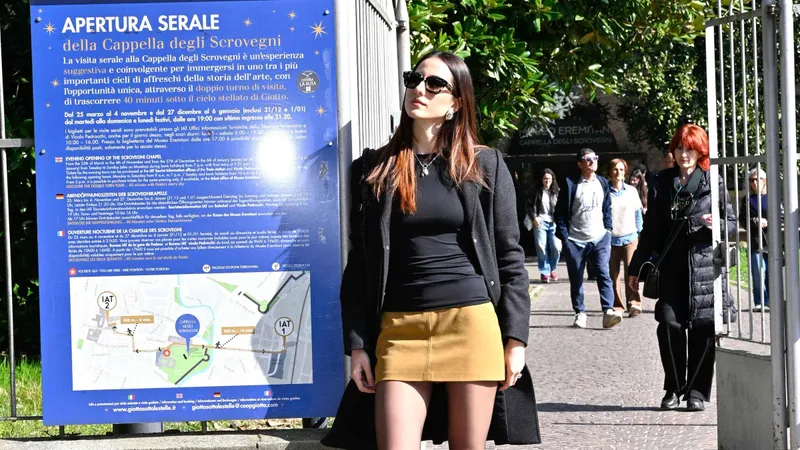 from $68.45
Padua: Evening Tour with Admission to the Scrovegni Chapel
The crowd-free evening slot with a city walk attached
Check AvailabilityPrices, ratings and details are the platform's own, checked in Q3 2026; dollar figures are the listed prices — the platform bills in your account's currency.
Frequently asked questions about the Scrovegni Chapel
What happens if I arrive late or miss my chapel slot?
A late arrival forfeits the slot — your booking code does not automatically carry over. Go to the ticket desk immediately: staff re-admit you to a later interval only if one is unsold, which in season almost never happens. The fix is procedural, not hopeful: arrive 30 minutes early, keep the code at hand, and never book a slot that abuts a train departure. More booking mechanics in how far ahead to book Scrovegni.
Can I take photos or videos inside the Scrovegni Chapel?
No. All photography and video are banned inside, including quick phone shots — staff enforce it, and the ban is what makes the climate system viable. The museum galleries and the Arena gardens are unrestricted, so plan your camera for before and after.
Is the chapel suitable for children?
Yes, and better than most museums: fifteen minutes is inside a child's attention span, the star-studded vault reads as a sky, and the Judgement wall's monsters hold their attention. Under-5s and pushchairs follow the museum route — check current family rules on the official site, and see our wider Padua with kids plan.
How long does the whole visit take?
Fifteen minutes inside the chapel, then two to three hours if you use the full combined ticket — Museo Eremitani, the church with the Ovetari frescoes, Palazzo Zuckermann and the Arena park. Call it a half-day block. A chapel-only dash is possible in under an hour, but the ticket is the same price either way.
How far ahead should I book the Scrovegni Chapel?
Weeks ahead in spring, early autumn and around Easter; months ahead for weekend slots in peak season; days ahead in the winter lull. Book the moment your travel dates are fixed — the calendar opens with slots for the whole current period, and the 15-minute intervals sell at a fixed pace. Our how far ahead to book Scrovegni planner has the seasonal detail.
What exactly does the combined ticket include?
The €16.00 total (€15.00 ticket + €1.00 mandatory booking; reduced €11.00, residents €7.00) covers the 15-minute chapel slot, the Museo Eremitani with its archaeological and gallery sections, and Palazzo Zuckermann. It does not cover the Urbs Picta Card's other UNESCO sites, and the booking fee applies to every category.
Is the chapel open on Mondays?
Yes — the chapel is open every day, 9:00-19:00 with last entry at 18:45, and closes only on 1 January, 1 May and 25-26 December. The Monday-closure habits of Padua's other museums do not apply here, which makes Monday the natural day to build the slot visit around.
Is the evening opening different from the day slot?
Same frescoes, different room. Giotto sotto le stelle sessions run on scheduled evenings with a separate portal (giottosottolestelle.it) and seasonal calendar; groups are smaller and the light is controlled for atmosphere. The evening guided tour with chapel admission in our catalogue achieves something similar on a fixed weekly rhythm and bundles the walk over from the centre.
What to visit near the Scrovegni Chapel
The chapel anchors the northern edge of the old town; everything below is within a ten-to-fifteen-minute walk of the ticket desk:
Scrovegni Chapel tickets
The full ticket and booking breakdown, with slot-by-slot advice and card arithmetic.
Piazza delle Erbe
The daily market square under the arcades of the great hall, ten minutes south.
Caffè Pedrocchi
The 1831 historic cafe between the squares — the natural post-slot coffee.
Things to do in Padua
The complete sightseeing index, ranked and grouped by district.
Padua in 1 day
How to sequence the chapel slot into a single-day route that actually works.
Reviewed Q3 2026 (July–September 2026); next review Q4 2026. Prices, hours and terms are set by the venue or operator and confirmed at checkout.
We may earn a commission if you book through one of our links, at no extra cost to you. Full affiliate disclosure